






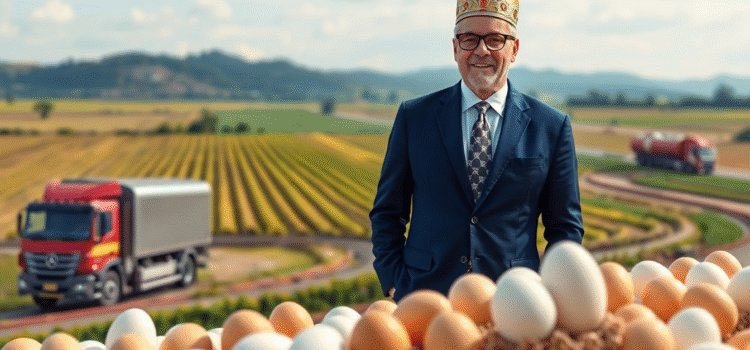
Brazil’s Egg King Acquisition of Hillandale Farms: Transforming the US Egg Market
Introduction
In a significant move within the global egg industry, Marcos Antonio Molina dos Santos, famously known as Brazil’s ‘Egg King,’ has acquired Hillandale Farms for an estimated $1.2 billion. Hillandale Farms, one of the top five egg producers in the United States, plays a pivotal role in the US egg supply, contributing to over 20 billion eggs annually. This acquisition raises intriguing questions about its impact on the US egg supply chain, freight costs, and overall egg market trends.
Readers will delve into the potential effects of this acquisition on the US agriculture sector, examining how the Brazilian egg company’s expansion into American territory may reshape the egg supply chain and logistics operations.
The Hillandale Farms Acquisition Impact
The acquisition of Hillandale Farms by Marcos Antonio Molina dos Santos highlights a critical shift in the egg market dynamics. This transaction not only underscores the strength of Brazilian agribusiness in expanding its global footprint but also signifies a strategic investment in the US agriculture sector. With Hillandale Farms accounting for around 20% of US egg production, the implications for the US egg supply chain are considerable.
Through experienced management and streamlined operations, it is anticipated that the acquisition will stabilize supply amidst fluctuating demands, influenced by factors such as avian influenza outbreaks. The continuity and predictability in egg production could potentially balance the market and mitigate unexpected changes in egg price fluctuations in the US.
Freight Costs and Logistics: A Post-Acquisition Outlook
Another significant aspect of this acquisition pertains to transportation costs for egg distribution. Under the new ownership, streamlined operations are expected to lead to enhanced efficiency, potentially reducing freight costs. Such operational changes could have a ripple effect across the supply chain, positively impacting logistics, storage, and distribution costs, thus influencing the overall price structure within the egg market.
Understanding Egg Market Trends Post-Acquisition
The integration of Brazilian business practices through Hillandale’s operational shift could bring transformative efficiencies. These changes may provide new avenues for collaboration, knowledge transfer, and heightened competitiveness as Brazilian businesses expand overseas. This aligns with broader trends in global egg market competition, presenting the potential to uplift production capabilities while navigating US-Brazil agribusiness relations.
- Streamlined logistics to optimize transportation costs.
- Stabilized US egg supply chain amid demand fluctuations.
- Potential reduction in egg price volatility.
- Strengthened global presence of Brazilian egg companies.
Conclusion
The acquisition of Hillandale Farms illustrates a strategic infusion of Brazilian investment into US agriculture. With potential improvements in the egg supply chain and logistics, stakeholders anticipate a more competitive and stable egg market. L recommend fostering open dialogue and observations within the industry to continuously monitor these evolving dynamics.
Readers are encouraged to share their thoughts on the implications of this acquisition in the comments section below.
Sources
Frequently Asked Questions
How does the acquisition impact the US egg supply chain changes?
The acquisition is expected to stabilize the supply chain amidst fluctuating demands and avian influenza outbreaks.
What are the freight cost impacts after the Hillandale Farms buyout?
Streamlined operations are anticipated to reduce transportation and logistics costs, affecting supply chain efficiency.
What role does the Brazilian agribusiness play in the US egg market?
The Brazilian agribusiness, through this acquisition, positions itself strategically within the US market, enhancing production capabilities.
Are there expected changes in egg price fluctuations in the US post-acquisition?
The acquisition aims to stabilize egg prices by improving supply predictability and operational efficiency.
Comments